

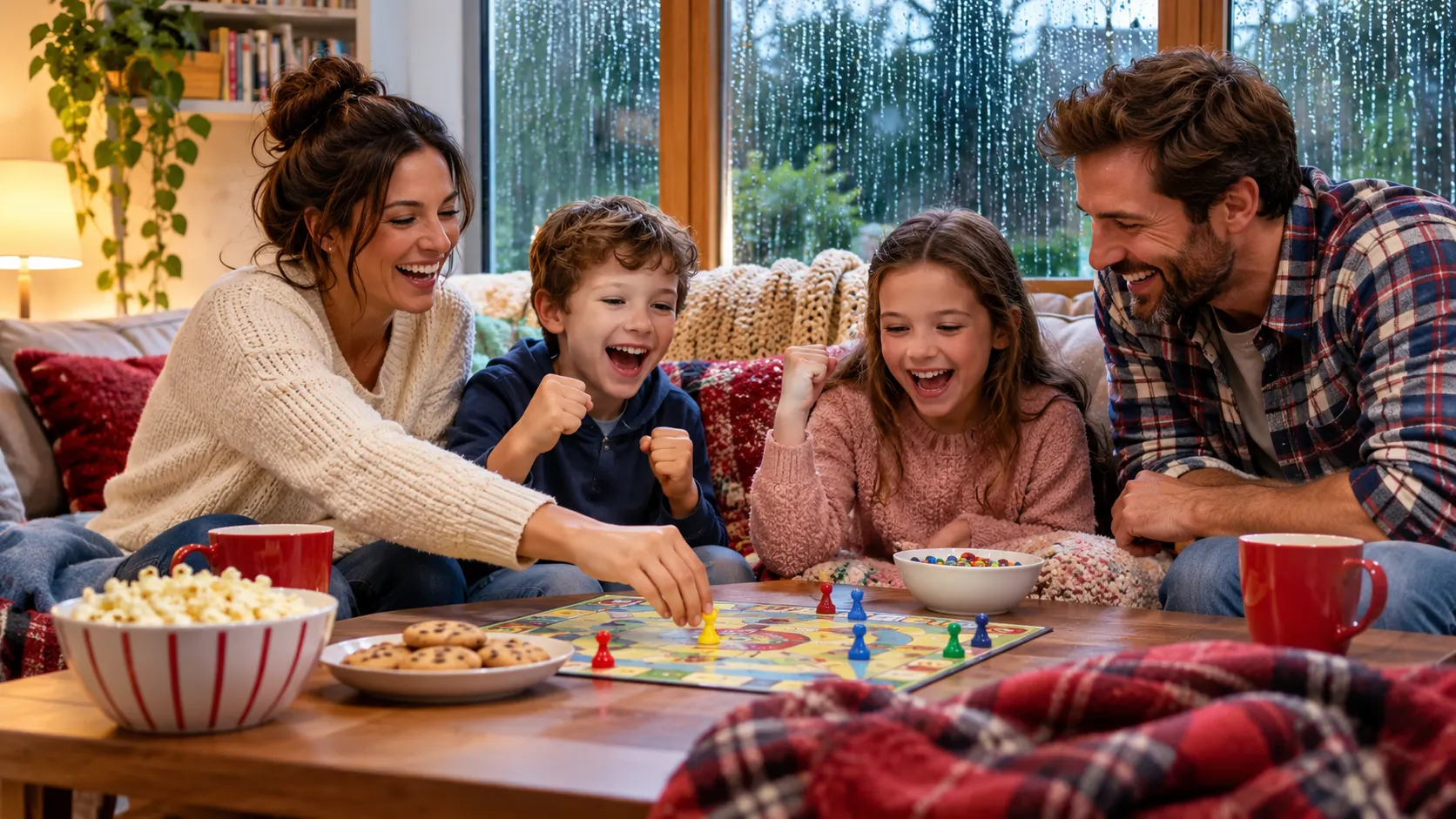
Rainy days can quickly change family plans, especially when outdoor activities are no longer possible. Children may become restless, while parents search for enjoyable ways to keep everyone entertained. Fortunately, fun indoor family games for rainy days can turn unexpected time at home into an opportunity for laughter, creativity, and meaningful family interaction.
Indoor games do not require expensive equipment, complicated preparation, or large playing spaces. Simple activities involving household items, imagination, and teamwork can provide hours of entertainment. From classic board games and scavenger hunts to guessing challenges and creative competitions, there are plenty of options for different ages and interests.
The best indoor family activities encourage participation, communication, and shared experiences without creating unnecessary stress. Whether your family enjoys active challenges, quiet games, or educational activities, choosing suitable entertainment can make a rainy afternoon more enjoyable. This guide explores easy indoor games, practical preparation tips, and creative ideas for spending quality time together.
Why Indoor Family Games Are Perfect for Rainy Days
Rainy weather often limits opportunities for outdoor play, making indoor entertainment especially useful for families. Games provide a structured way to enjoy time together without relying entirely on television or mobile devices. They can also help children stay engaged while giving parents opportunities to participate in enjoyable shared activities.
Playing games together encourages communication, cooperation, and problem-solving. Children may practice taking turns, following instructions, and responding appropriately when outcomes do not go their way. Adults can also enjoy relaxed conversations and playful experiences that differ from everyday responsibilities, creating opportunities for positive family interaction.
Indoor games can be adapted to different ages, abilities, and available spaces. Some activities require only paper and pencils, while others involve movement or teamwork. By choosing games that match your family’s preferences, you can create an enjoyable rainy-day routine without spending heavily on entertainment or equipment.
Classic Board Games for Family Entertainment
Board games remain popular indoor family activities because they encourage interaction and friendly competition. Many traditional games involve strategy, decision-making, and turn-taking, making them suitable for different age groups. Choosing a game with simple instructions can help younger players participate without becoming overwhelmed by complicated rules.
Games such as Ludo, Snakes and Ladders, and Checkers provide familiar entertainment for family gatherings. Older children and adults may enjoy strategy-based games that require planning and careful decisions. Families can also choose cooperative board games where everyone works toward a shared objective instead of competing individually.
Before starting, explain the rules clearly and make sure participants understand how the game works. Younger children may benefit from shorter playing sessions or simplified instructions. Keeping the atmosphere friendly and focusing on enjoyment rather than winning helps everyone feel included throughout the activity.
Indoor Scavenger Hunt for Kids and Adults
An indoor scavenger hunt turns familiar household spaces into an entertaining search adventure. Players receive clues or descriptions of objects they need to find around the home. This activity encourages observation, problem-solving, and movement while requiring very little preparation or specialized equipment.
Parents can create a simple scavenger hunt using everyday items such as books, socks, cushions, or colorful toys. Younger children may enjoy searching for objects based on colors or shapes, while older participants can solve written clues. Adjusting the difficulty allows everyone to participate at an appropriate level.
For additional excitement, divide participants into small teams and create a shared challenge. Establish clear boundaries about which rooms and objects are included, and keep fragile or unsafe areas off-limits. The goal is to enjoy creative exploration while maintaining a comfortable and safe indoor environment.
Charades: A Fun Guessing Game for Everyone
Charades is a classic indoor guessing game that requires imagination rather than expensive materials. One player silently acts out a word, phrase, or activity while others attempt to identify it. The game encourages creativity, observation, and communication through gestures and facial expressions.
Families can prepare simple topics such as animals, everyday activities, sports, or familiar story characters. Younger children may enjoy acting like a cat or pretending to brush their teeth. Older players can try more challenging phrases or situations, creating opportunities for entertaining and unexpected performances.
To keep the game enjoyable, allow participants enough time to act without feeling pressured. You can play individually or organize teams depending on the number of people involved. Encourage supportive reactions and laughter while avoiding criticism of anyone’s performance, especially when younger children are participating.
DIY Indoor Obstacle Course Challenge
An indoor obstacle course can provide active entertainment when rainy weather prevents outdoor play. Families can use cushions, soft toys, and other suitable household items to create a simple movement challenge. The activity encourages coordination, creativity, and problem-solving while allowing children to release some energy.
Create a short route involving stepping around cushions, crawling through an open space, or balancing along a line marked on the floor. Keep the setup low to the ground and remove sharp objects, slippery rugs, and unstable furniture. Avoid climbing challenges or anything that could cause falls.
Children can help design the course and suggest new challenges appropriate for their abilities. Rather than focusing on completing the route quickly, encourage careful movement and successful participation. Taking turns and changing the course occasionally can keep the activity interesting throughout the afternoon.
Family Trivia Games for Learning and Laughter
Trivia games combine entertainment with opportunities to learn interesting facts. Players answer questions about general knowledge, animals, geography, movies, or other familiar topics. Families can adjust the questions to match different age groups, allowing children and adults to participate together comfortably.
Begin by preparing a collection of questions with different difficulty levels. Younger players might answer questions about colors, animals, or everyday objects, while older participants explore history, science, or geography. Including questions related to family experiences can make the activity more personal and entertaining.
You can organize trivia into teams or let everyone answer individually. Keeping score is optional because the main purpose is enjoyment and learning. When someone gives an incorrect answer, use the opportunity to explain the correct information rather than making the player feel embarrassed.
Indoor Treasure Hunt With Creative Clues
A treasure hunt adds excitement to indoor family entertainment by encouraging players to follow clues toward a final surprise. Unlike a basic scavenger hunt, this activity usually involves a sequence of hints leading from one location to another. It can be adapted to small apartments or larger homes.
Begin by choosing a simple final reward, such as a homemade certificate, a favorite snack, or the opportunity to select the next family game. Hide written clues in appropriate locations around the home. Each clue should guide players toward the next destination without requiring access to unsafe spaces.
For younger children, use pictures or simple directions instead of complicated riddles. Older participants may enjoy solving word puzzles or interpreting creative hints. Parents can participate as guides, helping children stay engaged while ensuring the activity remains manageable and enjoyable for everyone.
Pictionary and Family Drawing Challenges
Drawing games provide a creative way for families to enjoy friendly competition indoors. In Pictionary-style activities, one participant draws an object or phrase while teammates attempt to guess the answer. The drawings do not need to be perfect, which often makes the guessing process more entertaining.
Prepare paper, pencils, and a collection of simple drawing prompts before starting. Possible topics include animals, household objects, food, or places. Younger children can draw familiar items, while older family members may enjoy more complicated concepts that require imagination and creative communication.
Another option is a collaborative drawing challenge where each participant adds something to a shared picture. This encourages cooperation rather than competition. Displaying the finished drawings can make the activity feel rewarding while providing a pleasant reminder of time spent together.
Fun Indoor Balloon Games for Families
Balloon games can provide light indoor movement when families have enough clear space. A simple activity involves gently keeping an inflated balloon in the air using open hands. Because balloons move slowly, players can practice coordination and teamwork without requiring complicated equipment.
Another option is passing a balloon between family members while remaining in designated positions. Participants can try completing a certain number of successful passes together. Choose an open area away from breakable objects, and avoid aggressive hitting or activities that encourage running into furniture.
Balloon activities require adult supervision, especially around young children. Uninflated balloons and broken balloon pieces can present choking hazards and should be kept away from children under eight. Families with younger children may prefer a lightweight soft ball or another age-appropriate alternative.
Memory Games to Improve Observation Skills
Memory games are simple indoor activities that challenge attention, observation, and recall. They can be played using picture cards, small household objects, or spoken information. These games offer an enjoyable way to practice concentration while allowing participants to adjust the difficulty.
For a basic memory challenge, place several familiar objects on a table and allow everyone to observe them briefly. Cover the objects, then ask players to remember what they saw. Younger children can begin with fewer items, while older participants may enjoy a larger collection.
Another variation involves arranging matching picture cards face down and taking turns revealing pairs. Players try to remember where previously viewed cards were located. Encourage patience and supportive participation so the activity remains enjoyable even when someone finds the challenge difficult.
Indoor Bowling With Household Items
Indoor bowling is an entertaining family activity that can be created using simple household materials. Empty plastic bottles can serve as bowling pins, while a lightweight soft ball provides the rolling object. This homemade version requires only a clear area and a little creativity.
Arrange the bottles in a small formation at one end of a hallway or open room. Mark a comfortable starting position and allow players to roll the ball toward the pins. Make sure the playing area is away from stairs, fragile objects, and furniture that could be damaged.
Families can create different challenges by changing the number or arrangement of pins. Younger children may benefit from a shorter rolling distance, while older players can attempt more difficult arrangements. Focus on taking turns, improving accuracy, and enjoying the activity rather than competing too seriously.
Family Puzzle-Solving Competition
Puzzles offer quieter entertainment for rainy days when families prefer relaxing activities. Jigsaw puzzles, word searches, and simple logic challenges encourage concentration and problem-solving. They can also create opportunities for conversation while everyone works toward completing a shared task.
Choose a puzzle based on the ages and interests of participating family members. Younger children may enjoy large pieces with colorful pictures, while older players can work on more detailed designs. Families can divide a puzzle into manageable sections or collaborate on identifying matching pieces.
For a friendly challenge, organize small teams and provide similar puzzles with appropriate difficulty levels. Avoid making completion speed the only measure of success, as some participants may prefer careful exploration. Celebrating teamwork and persistence helps maintain a relaxed and welcoming atmosphere.
Indoor Hide-and-Seek With Safe Boundaries
Hide-and-seek is a familiar family game that can be adapted for indoor entertainment. One player counts while others hide in approved locations, and the seeker attempts to find them. The activity encourages imagination and excitement without requiring special equipment or complicated preparation.
Before playing, establish which rooms and hiding spaces are allowed. Avoid closets with locking doors, storage containers, elevated surfaces, and areas containing hazards. Choose locations where participants can move safely and where adults can provide appropriate supervision for younger children.
Families living in smaller homes can modify the game by hiding a toy instead of hiding people. Players then search for the object using simple clues or warmer-and-colder hints. This variation provides similar excitement while making the activity easier to manage in limited spaces.
Creative Storytelling Games for the Whole Family
Storytelling games encourage imagination, listening, and creative expression through shared narratives. One family member begins a story with a simple sentence, and each participant adds another part. The resulting story may include unexpected characters, unusual situations, and entertaining changes in direction.
Start with an interesting prompt such as discovering a mysterious box or visiting an imaginary island. Allow everyone to contribute ideas without worrying about creating a perfect story. Younger children may prefer short sentences, while older participants can introduce more detailed characters or challenges.
You can also write down the completed story and invite family members to illustrate different scenes. This turns a simple speaking game into a creative project. Encouraging everyone to participate helps strengthen communication while giving each person an opportunity to contribute original ideas.
Music and Dance Games for Rainy Afternoons
Music-based games can create a cheerful atmosphere when families want active indoor entertainment. Activities such as freeze dance involve moving to music and stopping when the sound pauses. The rules are simple, making the game accessible to many age groups and enjoyable without extensive preparation.
Choose family-friendly songs that participants enjoy and provide enough space for comfortable movement. Keep the volume at a reasonable level and avoid slippery floors or crowded areas. Everyone can take turns controlling the music while others participate in the movement challenge.
Another option is a rhythm-copying game where one person creates a simple pattern using claps or taps. Other family members attempt to repeat the sequence. This activity combines listening and coordination while offering a quieter alternative to energetic dancing.
Educational Indoor Games for Children
Educational games can make rainy-day entertainment both enjoyable and mentally engaging. Word association, number challenges, and simple science-themed quizzes help children explore different skills through play. The activities work best when they feel like games rather than additional school assignments.
For a word association game, one player says a familiar word and the next person responds with a related term. Families can also play alphabet challenges involving animals, foods, or countries. Adjust the difficulty depending on each child’s age and familiarity with the selected topic.
Learning games should encourage curiosity without placing unnecessary pressure on participants. Offer hints when children struggle and recognize effort instead of focusing entirely on correct answers. A supportive approach helps maintain interest and creates positive experiences around learning at home.
Teamwork Games That Bring Families Together
Cooperative games encourage family members to work toward a shared objective instead of competing against one another. These activities can strengthen communication and allow everyone to contribute different ideas. Team challenges are especially useful when family members have different ages or abilities.
One simple activity involves building the tallest stable tower using blocks or empty cardboard boxes. Another option is completing a large jigsaw puzzle together. Participants can discuss strategies, divide responsibilities, and adjust their approach when the first idea does not work.
Teamwork activities provide opportunities to practice patience and respectful communication. Encourage family members to listen to suggestions and appreciate different contributions. When the challenge is complete, discuss which strategies were useful and how everyone helped achieve the shared goal.
How to Choose Indoor Games for Different Age Groups
Choosing appropriate indoor family games requires considering the ages, abilities, and interests of participants. Younger children often enjoy simple instructions, colorful objects, and shorter activities. Older children may prefer challenges involving strategy, problem-solving, or more complicated rules.
When several age groups play together, modify the game so everyone can participate meaningfully. For example, younger children might receive easier trivia questions, while older participants answer more challenging ones. Cooperative games can also work well because family members can contribute according to their individual strengths.
Pay attention to attention spans and comfort levels when selecting activities. Some children may enjoy energetic games, while others prefer drawing, puzzles, or storytelling. Offering a mixture of active and quiet entertainment helps create a balanced experience that accommodates different family preferences.
Tips for Planning a Fun Indoor Family Game Day
A successful indoor family game day begins with choosing a few suitable activities rather than preparing an overly complicated schedule. Select games that match your available space, equipment, and family interests. Keeping materials organized beforehand can make transitions between activities easier and reduce unnecessary interruptions.
Consider alternating active games with quieter options to maintain a comfortable pace. For example, follow an indoor bowling challenge with a puzzle or drawing activity. Include short breaks for refreshments, conversation, and relaxation so participants do not become tired or lose interest.
Allow family members to help choose the activities whenever possible. Giving everyone an opportunity to suggest games encourages participation and makes the experience more enjoyable. Remember that the purpose is to spend meaningful time together, not to complete every planned activity perfectly.
Conclusion
Rainy weather does not have to prevent families from enjoying memorable experiences together. Fun indoor family games for rainy days provide opportunities for laughter, creativity, teamwork, and learning. From scavenger hunts and board games to storytelling challenges and puzzles, there are many enjoyable activities suitable for different ages.
The best indoor games are simple to organize, comfortable to play, and adaptable to your family’s interests. Using everyday household materials can keep entertainment affordable while encouraging imagination. Combining active and quiet activities also helps create a balanced experience without requiring complicated preparation.
Spending time playing together can strengthen family connections and create enjoyable shared memories. Whether you have an entire afternoon or only a short break, a few thoughtfully chosen games can brighten the day. With creativity and a welcoming atmosphere, rainy afternoons can become some of the most enjoyable moments at home.
Frequently Asked Questions (FAQs)
What are the best indoor family games for rainy days?
Popular indoor family games include board games, charades, scavenger hunts, trivia, Pictionary, and puzzles. The best choice depends on your family’s ages, available space, interests, and preferred level of activity.
What indoor games can families play without equipment?
Families can enjoy charades, storytelling games, word association, memory challenges, and verbal guessing games without special equipment. These activities require imagination, communication, and simple instructions, making them convenient for rainy afternoons.
How do you entertain kids indoors on a rainy day?
Choose a mixture of creative, educational, and active indoor games. Activities such as drawing challenges, treasure hunts, puzzles, and simple obstacle courses can keep children engaged while encouraging participation and imagination.
What indoor family games are suitable for all ages?
Charades, cooperative puzzles, simple trivia, and storytelling games can work for different age groups. Adjust instructions and difficulty levels so younger children and older participants can enjoy playing together comfortably.
How can I make indoor family games more exciting?
Introduce creative themes, rotate activities, encourage teamwork, and allow family members to suggest challenges. Focus on friendly participation rather than intense competition to keep the experience enjoyable for everyone.

